This striking image by DP Marcus Waterloo from Vardis Marinakis's film Black Field is as good an introduction to the film's merits as anything I could say. Speaking in strictly visual terms, the film is a pure delight. The first third of the movie is so loaded with potent symbols that viewers might sense the coming of something miraculous - but, radiant cinematography aside, the whole does not really live up to expectations. It is still a beautiful film, with a confident, assured pace and masterful touch, but its themes are smaller than we are led to expect after witnessing the fantastic chiascuro images of the early scenes. It is a period drama set in Ottoman-ruled Greece in 1654; an escaped janissary (a Christian forced into service in the Ottoman army) washes up on the doorstep of a convent, where he is nursed (in chains) back to health and escapes with one of the nuns, who turns out to have been a boy all along. Their path takes them through some enchanted country, green and delicate, with rocks and pools glittering in patches of filtered sun or looming out of coils of mist. It all looks so much grander than the human story unfolding within it, which is essentially one of sexual awakening or gender liberation - no insignificant thing, to be sure, but not epic enough for this stage. I was wanting The Seventh Seal, or Macbeth, or something of that order. Early scenes, like that of the nun lying like a statue of carved stone in her stone-colored shroud, of an iron key in a slice of sunlight, the beautiful naked body of the man in chains attended by silent, black-clad women, the cremation and burial of the horse, the fog and flames and lightning, not to mention the liturgical atmosphere of the entire set, all combine to stir up the grandest possibilities imaginable. The film wants more gravitas to fulfill its promise, more complexity, perhaps simply more death, which would balance the life-affirming principle at work in the human theme and embody the shadows of its visual register. As it is, we are left with the curious feeling of having watched two films spliced together, and the loss of the one we want spoils the one we get.
Showing posts with label Films in MVFF33. Show all posts
Thursday, October 21, 2010
Saturday, October 9, 2010
MVFF33: 'Katalin Varga'
British sound artist and director Peter Strickland's beautiful first feature Katalin Varga is an impressionist film that resonates as much on the aural plane as on any other, so visual cues and plot development get behind what is often simply a powerful mood or feeling-tone signified by sophisticated effects in sound design and musical composition. It is a reversal in the usual order of things which haunts the mind in advance of events, and that implicates viewers in a weird way, weaving images which are spontaneously imagined together with those onscreen. In an interview with The Guardian Peter Strickland speaks frankly of his influences, and there are as many that have traveled through the ear as through the eye, including albums by The Cure and Suicide and the soundtrack (by Popol Vu) for Herzog's Nosferatu as well as films like Night of the Hunter and Paradjanov's Shadows of our Forgotten Ancestors.He speaks at some length as well of how the film came to be made. After suddenly inheriting 25,000 pounds from an uncle, and wondering briefly whether he should use the money to buy a flat, he set out instead for the Carpathian Mountains in Romania to make his first feature film with a crew of 11; the entire script is in Magyar translation, which Strickland doesn't speak but the actors do, so there was a lot of room for improvisation; without real access to the language, his ear was as tuned to the ambient sounds of "goat bells, crickets, and wind" as to human voices. The result is a film that situates human speech and action inside a broader natural context, so that the environment, which is after all the classic vampiric locale, begins to assume agency of its own. Landscape in this film is an obscure and fatalistic protaganist, deeply supernatural.
Hilda Peters plays the title character Katalin, who traverses the country with her young son in search of the men who raped her. Her performance is astonishingly protean, as she morphs from loving mother to trauma victim to seducer to avenger and back in the course of her quest. Her face alone is worth the price of admission. And the incredible face of her nemesis Antal, played by Tibor Palffy, completes the picture. They are profiles carved into opposite sides of the same magical coin. As soon as we see Antal we know - exactly what it is impossible to say - but we are charged with a sense of knowing, of significance, and his role thereafter fulfills this expectation in surprising ways. Pasolini was the great champion of 'real' faces such as these, and Strickland's casting illustrates his point to perfection. The right face carries the full weight of the story, its larger meaning as well as its specific human one.
With its haunting score (by Geoffrey Cox and Steven Stapleton), gorgeous photography (Mark Gyori), lean, intense dramatic arc, and forays into magical thinking and dark, folk-inflected myth, this film is a must-see for lovers of art, of music, and of the supernatural. Plays Smith Rafael 10/8 and 10/15. Also check out Strickland's sound world at http://www.soniccatering.com/. Here's the trailer;
Monday, September 27, 2010
MVFF33: 'Cut Poison Burn'
According to Nobel laureate and co-discoverer of DNA Dr. James Watson "the National Cancer Program is a bunch of shit", and this important film tells why. Wayne Chesler's Cut Poison Burn documents the ways in which pharmaceutical companies, and their creature, the American Cancer Society, in league with the American Medical Association and the FDA, govern the state of cancer treatment and research in this country by absolute decree, rewarding political candidates and CEOs and failing, to a staggering extent, the actual victims of this dread disease, their families, and the many brilliant independent research associates who struggle in vain to advance a real cure. Audiences will be interested to learn that a patient's life expectancy in 2010 has not, except in the case of 4 known cancers, increased at all since the 1920s when cancer research began in earnest; that patients today experience far greater suffering and diminishment in quality of life; that apparently benign fronts in the 'battle' such as Breat Cancer Awareness Month are PR fronts for purveyors of lethal drugs like Tamoxifin, known to cause uterine cancer in women; that research teams in universities across the country are routinely denied development grants for promising breakthroughs in non- or less toxic treatment options and are effectively squeezed out of the field anyway by FDA stipulations that new treatments be subjected to a staggering $1.6 billion of industry testing in order to qualify for approval. Since pharmaceutical companies (which constitute, incidentally, the largest lobbying sector in Washington bar none) are the only organizations capable of supplying such sums they have the entire industry of cancer research and treatment in a state of lockdown.
To make matters worse, parents of children with cancer are required by law to subject their kids to the entire battery of 'conventional treatment options' before they are allowed to seek alternative paths, and then only when the medical establishment has declared their child unable to withstand further treatment, a situation which usually involves the child being reduced to a virtual vegetable, bloated, hairless, riddled with secondary cancers, liver disease, and a whole host of other horrifying conditions including bone malformation and brain damage. The film follows the story of the Navarro family, who fight to the point of congressional hearings for the right to treat their 4-year old son at an alternative treatment facility in Texas. This facility, established by Polish Doctor Stanislaw Burzynski, has been treating patients with a non-toxic, non-patented amino-acid drip with enormous success, but the FDA had already barred the way to his door for the Navarros by reducing his clinic access to end-case patients only. The fate of this clinic is an interesting sub-plot in itself. In its determination to defend pharmaceutical companies' rights to dominate treatment options, the FDA waged a 13-year, $8 million legal battle to indict Burzynski on any and all charges available to the legal imagination, 75 counts in all, but were forced to merely sideline his clinic after prosecution failed on all counts to eliminate him from the game entirely. The fate of Dr. Burzynski, of other alternative-treatment practitioners, and of innovative scientists and research teams who have for decades now been thwarted and smeared as quacks by the ACS, not to mention the fate of patients like Tommy Navarro and tens of thousands like him, makes for a very sobering, sometimes infuriating, sinister and heartbreaking film, but it is an object lesson in how our country works and how, moreover, our own possible health trajectories might play out. I should add that the film is expertly produced, narrated, and formally balanced, not at all in the manner of some of Michael Moore's more strident if admirable efforts. It is an example of what great documentary filmmaking is all about. See this film. Playing 10/8 and 10/10 at the Smith Rafael Theatre in San Rafael. Jim Navarro's ongoing struggle for our right to alternative treatment options can be explored at http://www.cancerbusters.us/
Sunday, September 19, 2010
MVFF33: 'The King's Speech'
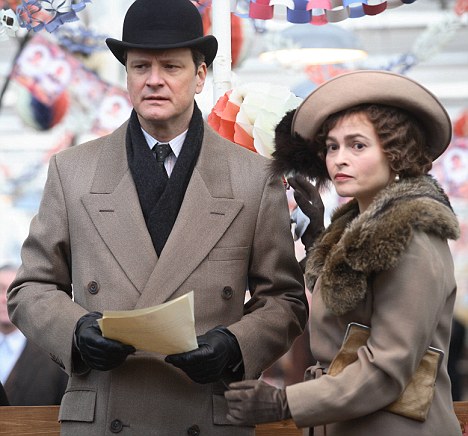
As winner of the People's Choice Award at this year's Toronto Film Festival, Tom Cooper's The King's Speech is set to become a hit with mainstream audiences in the States, as previous winners Precious and Slumdog Millionaire were before it, and owing to the performance of middle-aged heartthrob Colin Firth and of supporting actor Geoffrey Rush it will more than likely be a major presence in next year's Oscars as well. Yawn! At least with its nods to Bollywood Slumdog was fairly honest about its sugar content, but The King's Speech just pulls unremittingly on audience heartstrings without any irony whatsoever, sawing away at our pathetic fascination with well-dressed, well-meaning British gentlemen who are afflicted with an endearing touch of social anxiety but whose morals and conduct are above reproach. It's a caricature of Englishness that Colin Firth has built an entire career on. Here we find him one rung further up the ladder than usual - he is King George VI no less - but the character is essentially the same as the one he always plays, with some minor variations.Bertie, as he is known to his friends, has a fairly debilitating speech impediment which interferes with his royal duties as Duke of York but which threatens to become overwhelming when he is suddenly catapulted to the throne in the wake of his brother Edward's abdication in 1936 (to marry American divorcee Wallis Simpson). Fortunately for Bertie, his enterprising wife Elizabeth (played with predictable charm by Helena Bonham Carter) has already secured the services of unorthodox Australian speech therapist Lionel Logue (played by Geoffrey Rush), and the film is a study of their developing friendship, essentially of the ways in which Lionel manages to thaw out his heavily armored aristocratic client in time for him to embrace his royal destiny and deliver the speech of his life over national radio as Britain enters the war with Germany in 1939. You know you are in for some pretty high-calorie low-nutritional fare by the time Bertie makes his first breakthrough speech in Lionel's office, and the film continues in this vein as Bertie opens and snaps shut and opens again in the course of his treatment. It is a cleverly written and staged production, with enough humor and appropriate (superficial) questioning of privilege and class division to make us feel cosily acknowledged, but the story is chockful of that cloying sentiment which is symptomatic of emotional ill-health and is the unfortunate state of quite a few British films these days, another anodyne and intellectually-retarded exercise in winning the hearts, minds, and dollars of American audiences who don't know any better and don't want to. I enjoyed it - but not with the part of my brain that thinks.
Subscribe to:
Posts (Atom)